02.11.2021.
In respect to various controversial interpretations regarding the movements of inflation and financial stability indicators, the NBS uses the opportunity to once again explain to the public the inflation movements, its key factors, specific steps it has taken regarding inflation, as well as differences in responses of central banks in Central and South-Eastern European countries that are in the inflation targeting regime.
Inflation movements in 2021
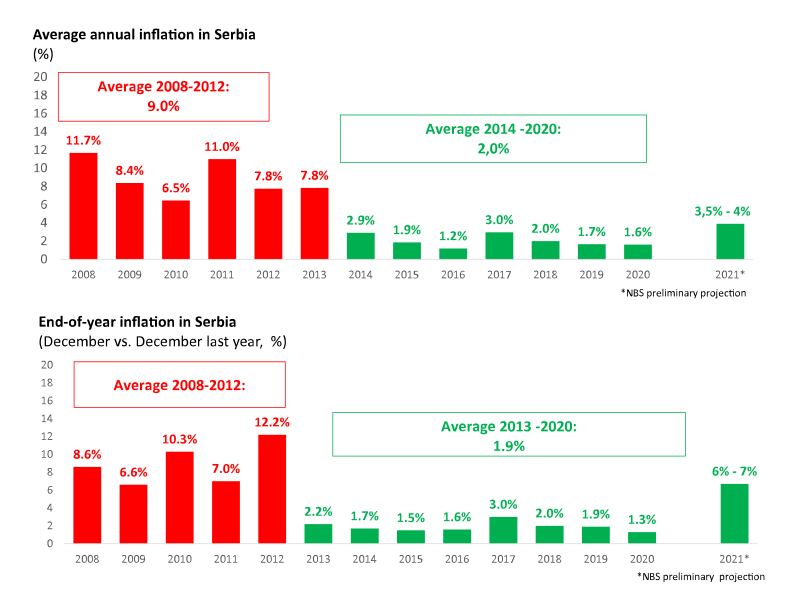
At end-2020 and in early 2021, due to low global oil prices, global prices of other primary commodities and unusually low prices of unprocessed food (vegetables, fruit and meat) in the domestic market, y-o-y inflation moved below the lower bound of the tolerance band – slightly above 1%. Inflation has been low and stable for the seventh year in a row, averaging around 2%. All economic agents in the Republic of Serbia – citizens, businesses and the government – benefit from this environment of monetary certainty and security. Along with the achieved and maintained stability of the RSD/EUR exchange rate, this has been and remained the basis for business certainty and the improvement of the domestic economy.
After the previous, pandemic year, which was characterised by very low inflationary pressures from the monetary aspect, in the second half of the current year we are facing higher inflation rates. We partly expected that would happen, because it is the result of a significantly low base from the previous year, i.e. of the mentioned low inflation. With global and domestic economic activity normalisation, the halts in global supply chains, the onset of a somewhat weaker new agricultural season and the resulting rise in the prices of unprocessed food and energy, inflation first returned to around the target midpoint (3%) in April, only to reach 4.3% and 5.7% in August and September, respectively, due to drought in the summer months and the unexpected hike in the global energy prices. However, we point out that the average y-o-y inflation in the period from January to September stood at 3.0%.
When it comes to September inflation of 5.7%, as we pointed out in our previous releases, almost two-thirds of that growth (3.6 pp contribution) is related to the factors that monetary policy cannot influence with its instruments (key policy rate, exchange rate policy and other instruments):
All of the above are mainly supply-side factors, i.e. factors that are present in other countries and which are “imported”, i.e. they are not an exclusive characteristic of the domestic market. If the NBS responded by tightening its monetary policy significantly, it would be able to slightly impact the factors such as food and energy prices, but such measures would do more harm than good to businesses and citizens, because, among other things, they would slow economic growth significantly, push the cost of loans up and jeopardize the financial stability of the country, which is directly associated with all economic parameters in the country, including the overall business environment and living standards of households.
The NBS is already using the instruments at its disposal, so the estimates, which have been made public on several occasions, that Serbia lacks monetary policy measures are completely incorrect. Comparisons suggesting that the NBS should act similarly to central banks in some neighbouring countries can only come from the part of the public that either does not follow the work of the NBS, or deliberately keeps silent about the facts. It is true that some central banks in the region have already tightened their monetary conditions – the NBS has done the same.
The differences regarding the tightening of monetary conditions in different countries are primarily associated with the level of core inflation, i.e. with the assessment of whether, and to what extent, a rise in food and energy prices spilled over to core inflation. Core inflation, which in some countries is higher than headline inflation, has been hovering around 2% in Serbia since the start of the year, largely due to exchange rate stability, which we have maintained even in the most difficult circumstances of the pandemic and the unprecedented global health and economic crisis.
What level of inflation can be expected over entire 2021 and further?
In the January–September period, average y-o-y inflation measured 3.0%. Given the global factors which still produce inflationary effects, average y-o-y inflation is expected at between 3.5% and 4% at the level of entire 2021.
Why do we emphasise average y-o-y inflation? Because it is the most objective measure of inflation, which is used across the world as the key measure of inflation when calculating other macroeconomic indicators. In addition, it is not appropriate to make conclusions about inflation based on its movements during a single or a few months only. In regard to end-of-year inflation, i.e. inflation in December, in y-o-y terms and according to preliminary projections, we currently expect it move in the 6–7% range. For the sake of reminder, in December last year, y-o-y inflation measured 1.3%, i.e. it was below the lower bound of the target tolerance band, and due to the low base, its somewhat higher level was expected by the end of this year. Thereafter, we expect inflation to move at those levels during the first quarter of 2022 as well, and return within the target band in mid-2022. Bearing in mind the effect of this year’s high base and the expected abatement of the global situation concerning food and energy products, we expect inflation to return to the target midpoint of 3% in the second half of 2022, or to even undershoot it.
Is the achievement of objectives in the interest of citizens and businesses, or is it a mere fulfilment of the form without results?
When it comes to the estimates of the former Governor which he publicly expressed, saying that the NBS is pursuing a monetary policy regime “that contravenes the official documents of our country”, we wish to use this opportunity to highlight once again that relative stability of the exchange rate and interventions in the interbank FX market are not in contravention with inflation targeting. Increasingly more papers of world economists are “catching up with” the long-standing practice of some developing countries with a pronounced level of euroisation/dollarisation – the stability of the local currency relative to the benchmark currency (the euro or dollar) is highly important for price and financial stability. Namely, interventions are the instrument supplementing the key policy rate and are not in a collision with it. Furthermore, numerous international financial institutions and rating agencies emphasise in their reports the credibility of monetary policy of the NBS and its contribution to the business environment and economic growth. Serbian businesses and citizens are not interested too much in “what is written in documents” or how the results are being achieved – they are interested in whether the results are being achieved or not. For years already, the exchange rate of the dinar against the euro has been relatively stable, and when planning investment and consumption, both businesses and citizens know that the exchange rate will remain as such. This is why we have significantly accelerated economic growth and doubled our fixed investment. Despite the pandemic, average economic growth during the two pandemic years will be around 3%, while the share of fixed investment will reach 24% of GDP already this year, which is a sound foundation for growth in the years to come. Exchange rate stability has also been one of the key factors behind average annual inflation moving at around 2% over the past seven years. Will inflation be above that level in 2021 as well? Yes, it will. It is certain that at the level of individual months, y-o-y inflation will for some time yet (most probably until mid-2022) move above the upper bound of the target tolerance band, but average y-o-y inflation will remain within the target band both in 2021 and 2022.
Such result will be more than twice better compared to average annual inflation, which measured as much as 9% in the period from 2008 to 2012 – over 50% if we observe it cumulatively over a five-year period. The reasons why Serbia had such high inflation in that period are numerous, but domestic factors prevailed. Monetary and fiscal policy makers of the time did not undertake adequate measures under numerous formal excuses, the dinar lost a third of its value from 2008 until mid-2012, the problem that drove four state-owned banks into bankruptcy escalated, while wages and pensions were raised durably in a non-sustainable way and contrary to economic capacities at the time – these are only some of the examples. The inability of those people to even after almost a decade give a simple answer to the question “whether they made any mistake in the period while they pursued the economic policy”, is perhaps the best answer to the question why in that period the results for citizens and businesses were entirely absent. External factors doubtless partially affected such results, but the scope of the then and the present-day crisis is incomparable. In 2009, euro area’s GDP contracted by 4.4% and average annual inflation stood at only 1.8% in the 2009–2012 period. For the sake of comparison, euro area’s GDP fell by 6.4% in 2020 and euro area y-o-y inflation has already exceeded 4%.
Governor’s Office