
18.11.2026.
The National Bank of Serbia (NBS) published today the Inflation Report – November 2026, presenting the latest macroeconomic developments, new inflation and economic activity projections, as well as factors underpinning the monetary policy decisions in the period since the previous Report.
In summary, unlike in the previous period, when the inflationary effects of the energy shock were limited, the new inflation projection points out the risk of their extended duration and spill-over onto other prices. In an environment of stronger domestic demand and faster real wage growth than previously anticipated, the risk of second-round effects on inflation has increased. Therefore, the Executive Board estimated that the monetary policy tightening is needed to contain inflationary pressures and ensure inflation’s return within the target tolerance band over the medium term.
In the period since the previous Report, y-o-y inflation in Serbia continued to move within the NBS target tolerance band. In July and August, it was below the target midpoint, thanks primarily to this year’s excellent fruit and vegetable harvest. It rose to 4.1% in September, mostly driven by the low base effect for the prices of food and household chemical products, as well as by elevated petroleum product prices. In October, y-o-y inflation reached 4.4% as petroleum product prices continued up and food prices increased. The prices of food and non-alcoholic beverages rose for the first time in over a year in y-o-y terms, by an average of 1.2%. One year-ahead inflation expectations of the financial sector rose moderately over the past several months, but remained within the target band, while medium-term expectations remain anchored around the target midpoint of 3%.
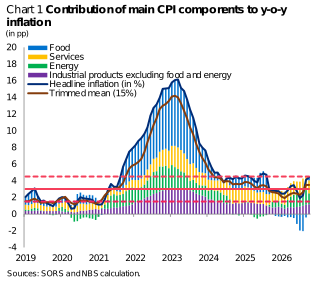
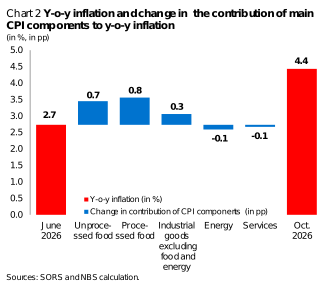
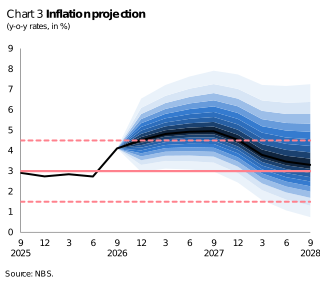
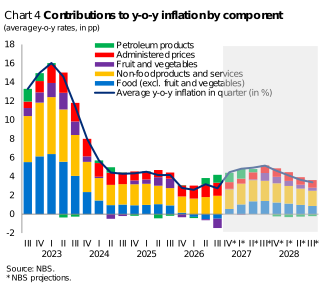
The NBS expects inflation to move around the upper bound of the target band until the end of 2026 and to hover above it for most of 2027.
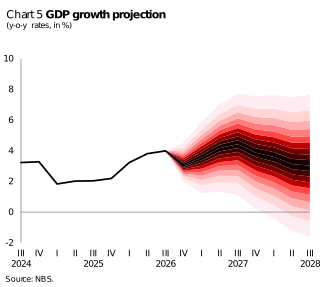
According to the SORS flash estimate, real GDP growth in Serbia accelerated further to 4.0% y-o-y in Q3 this year, exceeding our August expectations. In the NBS’s estimate, the largest positive contribution to this came from the services sectors, propped up by continued growth in private consumption and real household income, with construction and agriculture also providing a positive impulse. By contrast, industrial production almost stagnated, partly on account of low water levels, which hampered electricity generation and transport. Within manufacturing, more than half of the branches recorded growth, with the strongest increases seen in the manufacture of motor vehicles, machinery and equipment, as well as food and chemical products.
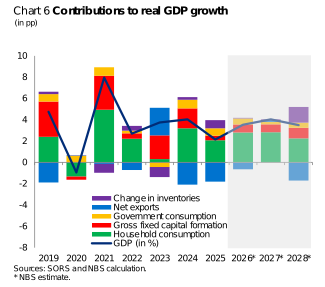
We have revised up our GDP projection for 2026, from 3.2% to 3.5%, on account of better economic activity outturns in the year to date than anticipated in August, as well as improved agricultural outputs according to the SORS estimate and accelerated construction growth. The projection for 2027 was downgraded from 4.5% to 4.0% due to this year’s higher base, extended energy shock and lingering geopolitical tensions. According to the projection, domestic demand will remain the key driver of economic growth in the coming period, with both consumption and fixed investment making a positive contribution, supported by growth in disposable income, FDI inflow and continued implementation of infrastructure projects. Net exports will also make a positive contribution in 2027, thanks to expanded export capacities and higher exports of goods and services associated with the Expo. The contribution of net exports is, however, now projected at a somewhat lower level than in August, reflecting the extended duration of the energy shock and marked geopolitical and trade tensions. In the medium term, we expect the impact of temporary factors to dissipate gradually and growth to stabilise at around 3.5% p.a., which is consistent with the estimated potential growth of the domestic economy.
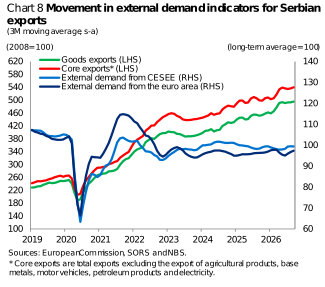
Despite weak external demand and higher energy imports, exports of goods and services continued to grow faster than imports. In the first nine months of 2026, goods and services exports increased by 8.7% and imports by 6.7%, with the export-to-import coverage ratio reaching a record high of 94%. Export growth was driven by manufacturing, primarily industries linked to the automotive sector, as well as exports of copper ore, ICT and business services. On the import side, the largest contribution came from increased demand for energy products.
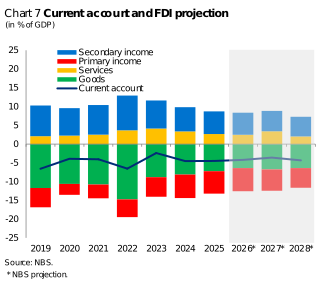
As a result of the lower deficit on trade in goods and services, the overall balance of payments current account deficit amounted to 3.6% of GDP in the first nine months of this year. According to the NBS’s new projection, the current account deficit is expected to reach around 4.2% of GDP in 2026, broadly in line with last year’s level. In 2027, it is expected to narrow to around 3.6% of GDP, supported not only by a gradual recovery in external demand and an expansion of export capacity, but also by growth in exports of services related to the organisation of the Expo.
The main risks to the materialisation of macroeconomic projections stem from the international environment, primarily the uncertain duration of the conflict in the Middle East and further developments in global energy prices. Given the persistent uncertainty surrounding geopolitical developments, the Report also presents alternative projection scenarios.
Depreciation pressures have been present in the local FX market since the second half of September, primarily reflecting increased demand for foreign exchange by energy importers. These pressures intensified further in October, also reflecting increased demand for foreign exchange and foreign cash by households. In October, the NBS sold EUR 865.0 mn net, bringing its net FX sales since the beginning of the year to EUR 1,340.0 mn. Despite the NBS’s FX market interventions on the sale side, FX reserves remain at a relatively high level. At end-October, FX reserves stood at EUR 29.2 bn, covering 6.5 months of imports of goods and services, well above the adequacy criteria. This reaffirmed the NBS’s commitment to maintaining relative exchange rate stability, which contributes to price and financial stability, as well as greater business certainty.
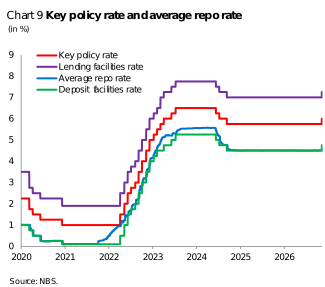
As previously noted, in considering the November inflation projection and taking into account all the aforementioned factors, the NBS Executive Board decided at its November meeting to raise the key policy rate by 25 bp to 6.00%. As a reminder, at its previous meetings in September and October, the Executive Board also pointed to the risks that the conflict in the Middle East and rising global energy prices could lead to higher production and transport costs worldwide, disruptions to supply chains and capital flows, as well as second-round effects on other prices. On those occasions, the Board also noted that domestic inflation in the period ahead could be higher than projected in August.
In deciding to raise the key policy rate, the Executive Board took into account that, although monetary policy cannot directly influence global energy prices, it can limit the pass-through of their increase to inflation expectations and other prices. This is particularly important in an environment where the prolonged duration of cost-push pressures, combined with stronger domestic demand, increases the risk of a more persistent rise in inflation.
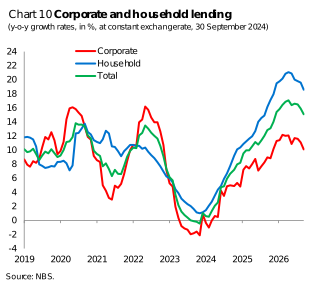
Despite a certain increase in lending rates in previous months, bank lending activity remained robust in the third quarter, with total loans recording y-o-y growth of 15.1% in September. Corporate loans increased by 10.1% y-o-y, primarily driven by growth in investment and liquidity loans, while household lending grew by 18.6%, supported by cash and housing loans. At the same time, the share of non-performing in total loans remained below 2%. The continued strong growth in lending activity, particularly to households, indicates that financing conditions remain supportive of domestic demand. Under these circumstances, a moderate increase in the key policy rate helps contain the risk of a further strengthening of demand-side inflationary pressures. Timely monetary policy action reduces the risk of more substantial monetary tightening being required in the period ahead, which would entail higher costs on economic activity.
In late October, the NBS revoked the operating licence of Alta banka in order to protect the interests of depositors and creditors. The bank was not classified as a systemically important bank and accounted for around 3% of the banking sector’s total assets. Accordingly, the revocation of its operating licence will not affect the stability of the banking system as a whole, which remains well-capitalised and highly liquid. The NBS transferred the administration of Alta banka to the Deposit Insurance Agency, which has sufficient funds to ensure that all deposits covered by the statutory deposit insurance scheme are repaid in full, up to the insured amount, within a short period.
The NBS will continue to monitor and analyse developments in domestic and international markets and make decisions on the future course of monetary policy on a meeting-by-meeting basis, depending on incoming data, with a view to ensuring medium-term price and financial stability and supporting further growth in economic activity and employment.
Governor`s Office


