
30.10.2026.
The World Savings Day is observed every year on 31 October, reminding us of the importance of savings for the financial security of individuals and the stability of society as a whole. By saving, i.e. deferring current consumption to the future, citizens build a basis for coping more easily with unexpected expenses and economic uncertainties.
In Serbia, household savings have been growing steadily, and this trend continued in 2026, when they reached record levels despite persistent global uncertainties and challenges. Dinar savings have recorded particularly vibrant growth in recent years, reflecting citizens’ long-term confidence in the domestic currency and the stability of the banking system. Growth in total savings, and particularly faster growth in dinar relative to FX savings, has primarily been driven by macroeconomic and financial stability over a prolonged period.
According to the latest operational data, dinar savings stood at around RSD 250 bn at end-October, an increase of as much as RSD 42.8 bn (21%) relative to early 2026. FX savings also rose over the same period, by EUR 1.3 bn (7.9%), reaching EUR 17.4 bn.
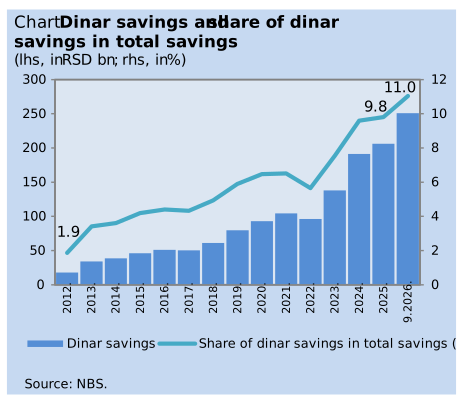
Owing to faster growth in dinar than in FX savings, the share of dinar in total household savings reached 11% at end-September, a significant increase given that it stood at only 1.9% in September 2012. In terms of the maturity structure of dinar savings, the largest increase was recorded for savings with the maturity of six months to one year (RSD 29.3 bn), which is also the most prevalent category in total dinar savings (57.6%), followed by savings with the maturity of three to six months (RSD 12.2 bn), while demand savings increased by RSD 6.8 bn. The average amount of dinar savings per account stood at RSD 223,000 at end-September 2026. However, excluding savings deposits of up to RSD 10,000 (which account for 82.6% of the total number of accounts but only 0.2% of the total amount of dinar savings), the average amount of dinar savings per account stood at RSD 1.3 mn.
Over the past 14 years, since the implementation of the Strategy of Dinarisation of the Serbian Financial System began, household savings in the domestic currency have increased almost 14-fold. FX savings have also expanded over this long-term period, albeit at a somewhat slower pace. Since September 2012, they have more than doubled, rising from EUR 7.9 bn to EUR 17.2 bn at end-September 2026. In the first nine months of 2026, FX savings increased by more than EUR 1 bn, primarily as a result of growth in savings with the maturity of six to twelve months (EUR 616.6 mn) and demand savings (EUR 468.0 mn), which account for the largest share of FX savings. The average amount of FX savings per account stood at around EUR 4,500 at end-September 2026. Excluding the most numerous category of deposits (up to EUR 500), which accounts for 71.4% of the total number of accounts but only 0.6% of the amount of FX savings, the average savings deposit amounted to more than EUR 15,600.
Current trends
Y-o-y inflation in Serbia stood at 4.1% in September this year, within the NBS target tolerance band (3±1.5%), while average inflation in the first nine months of 2026 was lower, at 2.8%.
In the first nine months of 2026, the dinar continued to move relatively steadily against the euro, supported by NBS interventions in the interbank FX market. During this period, the NBS was a net seller of EUR 475 mn, responding to depreciation pressures, which prevailed in the first three months of the year and in September, while appreciation pressures predominated from April to August. At end-September 2026, gross NBS FX reserves amounted to EUR 29.6 bn, covering 6.7 months’ worth of imports of goods and services and being significantly above adequacy standards.
The dinarisation indicator for corporate and household deposits also stood at 46.9% in September 2026, more than double its September 2012 level of 18.8%. This attests to the success of the Strategy of Dinarisation of the Serbian Financial System and provides further evidence of stronger confidence among citizens and businesses in the domestic currency.
Higher returns on dinar savings confirmed by the latest analysis
The regular analysis prepared on the occasion of the World Savings Day once again confirmed that, in the period from September 2012 to September 2026, savings in dinars generated higher returns than comparable savings in euros, irrespective of the maturity.
The higher returns on dinar savings are attributable to higher interest rates on dinar savings than on euro savings, the exemption of interest income from dinar savings from taxation, and the relative stability of the RSD/EUR exchange rate.
According to the analysis, if a person placed RSD 100,000 in a one-year term deposit in September 2012 and rolled it over annually over the following 13 years, they would receive over RSD 60,000 (more than EUR 510) more at the end of the deposit period, in September 2026, than a depositor who placed the equivalent of the same amount in euros over the same period (Table 1).
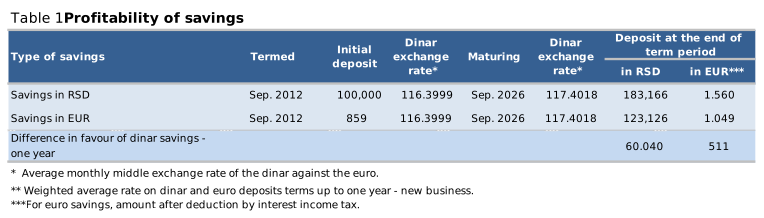
Over the 14-year period, one-year dinar term deposits (without rollover) generated higher returns than comparable euro deposits in as many as 99% of the annual subperiods observed.
For example, if a person placed a RSD 100,000 one-year deposit in September 2025, by the end of the deposit period (September 2026) he would receive almost RSD 1,800 (EUR 15) more than a depositor who placed the equivalent of RSD 100,000 in euros over the same period (Table 2).
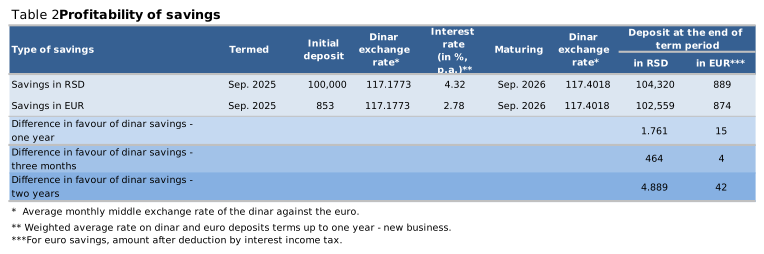
As regards other deposit maturities, three-month term deposits in the domestic currency generated higher returns than comparable euro deposits in more than 92% of the quarterly subperiods observed, while two-year dinar term deposits generated higher returns than comparable euro deposits in all the two-year subperiods observed.
The results of the analysis unequivocally confirm that, over the past 14 years, savings in the domestic currency have generated significantly higher returns than savings in euros, both in the short and long run.
The NBS will continue to monitor and analyse household savings trends and promote the dinarisation of the financial system, while informing the public about the results of analyses of the profitability of savings in domestic and foreign currencies. Growth in savings and citizens’ confidence in the banking system are important pillars of household financial security and long-term economic development.
Governor's Office


