27/08/2026
Household savings, both in dinars and in foreign currency, have continued to grow in 2026, reaching new record levels. According to the latest, still operational, data, by mid-August, dinar savings exceeded RSD 244 bn, representing an increase of as much as RSD 37.9 bn (18.4%) since the beginning of 2026. As a result, dinar savings exceeded the equivalent of EUR 2.0 bn for the first time, while FX savings reached EUR 17.0 bn, also marking the highest level to date. In line with the faster growth in dinar compared to FX savings, the share of dinar in total household savings exceeded 10% for the first time during H1 2026. This represents significant progress, given that this share was below 2% in June 2012.
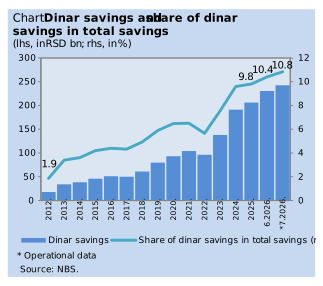
The results of the latest semi-annual Analysis of the Profitability of Dinar and FX Savings, covering the period from June 2012 to June 2026, showed that over the past 14 years, dinar savings have been more profitable than FX savings, both in the short and long term.
The higher profitability of dinar compared to FX savings is primarily supported by the relative stability of the dinar/euro exchange rate, higher interest rates on dinar than on euro savings, and more favourable tax treatment, as interest income from dinar savings is not subject to tax.
Savings in the domestic currency have increased more than thirteenfold over the past 14 years, reflecting citizens’ confidence in the dinar and the banking sector. In terms of the maturity structure of dinar savings, the largest increase in the first half of 2026 was recorded in savings with a maturity of six to 12 months (RSD 16.1 bn), which also account for the largest share of total dinar savings (56.9%), followed by savings with a maturity of three to six months (RSD 9.2 bn). At end-June 2026, the average amount of dinar savings per account stood at more than RSD 205,000.
Looking at the same 14-year period, FX savings more than doubled, from EUR 7.9 bn in June 2012 to EUR 16.9 bn at end-June 2026. In the first half of 2026, FX savings increased by EUR 735.5 mn (4.6%), mainly driven by an increase in savings with a maturity of six to 12 months (EUR 443.2 mn) and sight deposits (EUR 334.8 mn), which account for 64.7% of total FX savings. At end-June 2026, the average amount of FX savings per account stood at more than EUR 4,000.
Since September 2025, inflation has remained within the target band, slowing to 1.9% y-o-y in July 2026.
During the first seven and a half months of 2026 (data as at 20 August), the relative stability of the dinar against the euro was maintained, supported by NBS interventions in the IFEM, with net sales of EUR 185.0 mn. The gross NBS FX reserves stood at EUR 30.5 bn at end-July 2026, their highest end-of-month level on record. This level of FX reserves provides coverage of seven months of imports of goods and services, twice the level stipulated by the relevant international standard.
Since the implementation of the NPL Resolution Strategy began in August 2015, the share of NPLs in total loans has been slashed from 22.4% to a record low of 2.0% in June 2026.
In July 2026, Fitch Ratings confirmed Serbia’s positive outlook for an investment-grade rating for the second time this year, while maintaining the country’s credit rating at BB+. The agency highlighted that Serbia’s credit rating is supported by an appropriate policy mix, including a strong commitment to maintaining exchange rate stability, prudent fiscal management, high FX reserves, and higher GDP per capita compared with rating peers.
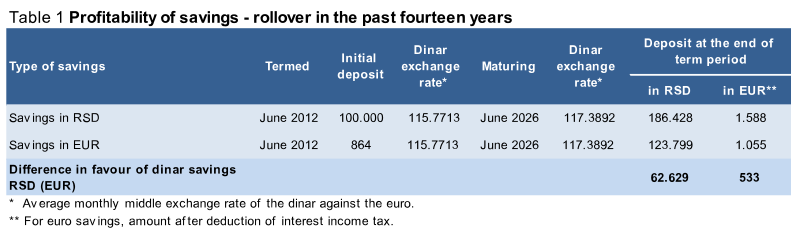
The analysis of profitability of savings termed for one year, with rollover during 13 years (since June 2012), confirmed that a depositor who saved in dinars, placing a RSD 100,000 deposit, would receive, at the end of the savings term in June 2026, over RSD 62,600 (close to EUR 533) more than a depositor who deposited the equivalent amount in euros during the same period (calculated using the average RSD/EUR exchange rate in the month of depositing) (Table 1).
Dinar savings termed for one year without rollover also proved to be more profitable than savings of the same maturity in euros in almost 99% of the observed annual subperiods (155 out of 157).
To illustrate, a person who deposited RSD 100,000 in June 2025 would receive almost RSD 1,800 more in June 2026 compared to a depositor placing the euro equivalent in the same period (Table 2).
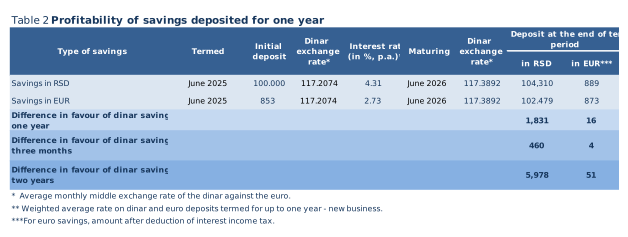
The results of the analysis show that dinar savings termed for three months (without rollover) turned out more profitable than euro savings of the same maturity in more than 92% of the observed three-month subperiods, while dinar savings termed for two years were more lucrative than euro savings in all the observed two-year subperiods.
In other words, the analysis shows that in the past 14 years it was more lucrative to save in dinars in both short and long run.
Promoting savings in the domestic currency is an important component of the strategy of financial system dinarisation. Therefore, the NBS will continue to emphasise the higher profitability of dinar savings in the period ahead, while continuing to monitor and analyse developments in savings.
Monetary and FX Operations Department