21/01/2022
In response to repeated blatant falsehoods, attempts at manipulation and misinterpretation of data by which former governor of the National Bank of Serbia Mr Dejan Šoškić strives to present in a tendentious and untruthful way his own work and the state of the Serbian economy during his time as governor, as well as the current state of the Serbian economy and the work of the incumbent economic policy makers, most recently in the weekly NIN, the National Bank of Serbia (NBS) points to the following facts:
The question “The authorities blame you also for the 6.5% inflation in 2010, in 2011 it was 11%, and in 2021% it measured 7.8%. Have they accidentally disregarded that inflation in 2010 and 2012 was lower than in 2021?” contains untruthful assertions. For the sake of truth, we present a table with official data on inflation so that the periods selected by the journalist could be compared properly.
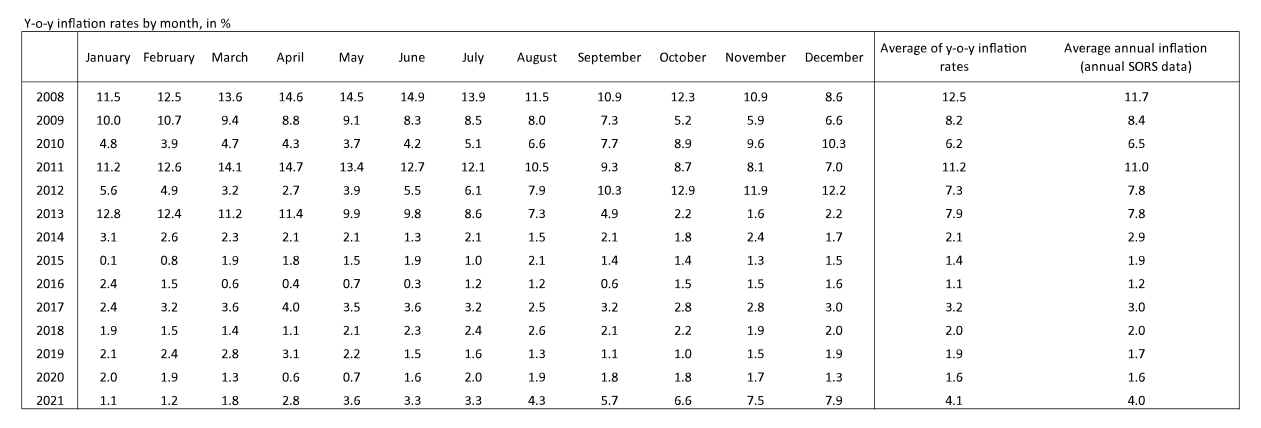
Average annual inflation in 2021 measured 4.0% and was clearly lower than the average inflation of 6.5% in 2010 and 7.8% in 2012. The conclusion is the same even if we compare the y-o-y inflation rates at the end of those three years, with y-o-y inflation ending 2010 and 2012 at double-digit levels (10.3% and 12.2%). And no, these years are not comparable because 2021 is the year of an unprecedented global shock. Like in most countries worldwide, since mid-2021 inflation in Serbia is driven by the elevated global prices of energy and other primary commodities, disrupted supply chains and considerably higher prices of transport globally.
In the introductory part of the interview Mr Šoškić places focus on manipulation, which, in his view, politicians are prone to. And yet, using antithesis as his main figure of speech and by propounding only unsubstantiated assessments, he himself engages in manipulation too. Does that make Mr Šoškić a politician as well?
Manipulation is everything – starting from the assertion that a strong exchange rate of the dinar serves to create an illusion of progress, all the way to stressing that for the poorest categories of the population inflation is much higher than officially disclosed. We will repeat the data that we often present and that are publicly available – since 2017, i.e. in the last five years (2017–2021), the NBS bought EUR 4.2 bn net in the local FX market. We responded to pronounced appreciation pressures.
The conclusions are the same even if we analyze data for the last almost ten years, which is a period that ensued after the people voted against the results of those who had been running a detrimental economic policy. From August 2012 all the way until the end of 2021, the NBS was a net buyer of foreign exchange, buying EUR 3.1 bn and thus offsetting excess FX supply. This means that through its net purchases of foreign exchange last year, as well as in the last five and ten years, the NBS was preventing the dinar from strengthening too much, which is contrary to the omnipresent hypothesis of the former governor that the NBS is averting the dinar’s weakening. Further, we will not leave out the fact that since August 2012 we have increased the country’s FX reserves by EUR 6.3 bn, and more importantly, that we have done so while the government net repaid a considerable portion of its FX debt.
Besides, the exchange rate policy pursued by the NBS contributes significantly to the achievement of the main central bank objectives (monetary and financial stability), and not to illusions about anything.
Another attempt at manipulation is his statement about much higher inflation for the poorest categories of the population. Taking care about its citizens, the government adopted measures to temporarily cap the prices of staples and commercial electricity, while valuable support to our citizens in the temporary pandemic-induced circumstances also came through across-the-board cash payments.
In terms of average annual inflation in 2011 discussed in the interview, please note that it measured 11.0% at the time, which is almost three times higher than in 2021. What is not being said is that in those years the Serbian government was running an irresponsible fiscal policy, increasing public sector wages and social transfers way beyond the economic capacities. What speaks volumes about the “quality” of the then policies is the fact that the arrangement with the IMF signed in late 2011 was suspended already at the start of 2012, which means that Serbia failed to pass even the first performance review.
There is an essential difference between the fiscal policy of today and the irresponsible fiscal policy of the past – pension and wage increases are indeed high, but they are sustainable as well, because they are in line with the nominal GDP growth.
In response to assertions that the ongoing inflation growth remains without an appropriate monetary policy response, we have to recall that from end-2013 through mid-2021 inflation in Serbia was at or close to the level of around 2%, and that this was the first time that Serbia had an inflation rate comparable to that of European countries. The period before that was marked by inflation that was higher and more volatile, often even double-digit, reaching in several instances almost 15% (June 2008, April 2011).
For years back the NBS has been implementing its repo operations at the effective repo rate and not at the key policy rate, and only someone not familiar with this fact can claim that the current inflation is left without an appropriate monetary policy response. The flexible system of variable rate auctions that we have introduced enables us to respond more frequently and timely to various market distortions. Since last October we have increased the effective repo rate from 0.11% to 0.63%, which is practically equivalent to two 0.25 pp hikes of the key policy rate. Any sharper tightening of monetary policy in a situation when three-quarters of y-o-y inflation are due to food and energy prices is hardly opportune. A decision in that direction is not supported by our current projection either. Namely, under our current projection, inflation will start falling in the second quarter, return within the target tolerance band by the end of the third quarter and settle around the target midpoint at year-end.
Further, repeating the mantra of “the wrong exchange rate policy” and “the overestimated dinar” over and over again will not make it true, just as correlating exports, the current account deficit and the exchange rate will stay without any solid foundation in figures and facts. Compared to 2012, Serbia’s external imbalances narrowed down dramatically. All it takes to arrive at the right conclusions is a look at the volume of Serbian exports, the rate and period of export increase, the structure of exports and whether it has changed. Serbia’s exports of goods and services increased from EUR 11.5 bn in 2012 to over EUR 28 bn in 2021. Export growth of around 150% in that period, or around 11% per year, is the best proof that the exchange rate policy was no obstacle to export growth in that period. It was quite to the contrary. Export growth is led by manufacturing, whose exports rose from EUR 7.5 bn in 2012 to EUR 19 bn in 2021, and there is no branch of manufacturing that hasn’t contributed to such outcome.
The current account deficit amounted to 10.3% of GDP in 2011 and to 10.9% in 2012. Then from 2013 onwards it ranged between 2.9% and 6.9% of GDP, with expected stabilization at around 4% of GDP. A large part of the improvement in Serbia’s external position is owed to trade in goods and services. The deficit on trade in goods and services that equalled EUR 5.5 bn in 2012 will be less than EUR 4.5 bn in 2021. Export structure is dominated by manufacturing and ICT, transport, business and tourist services, while an increasing share of imports is accounted for by equipment and intermediate goods for the needs of investment and industry.
Owing to the maintained stability, we are also a half a step away from getting an investment-grade rating, and investment in the country is multiple times higher. In 2021 foreign direct investment reached the record high of EUR 3.9 bn, and we estimate that total fixed investment will amount to around 24% of GDP or around EUR 12.5 bn. This level of investment is considerably higher than in the period 2009–2012, when total fixed investment averaged around EUR 6 bn a year, or around 18.5% of the then, significantly lower GDP.
When talking about average wages and GDP, their conversion to euros, and assertions that the “strong” dinar has increased the amount of wages and GDP in euro terms, we inevitably return to the indisputable fact that in the past five years the NBS was not a net seller, but a net buyer of foreign exchange. Our interventions aimed not to prevent the dinar’s weakening, but rather its excessive strengthening. If we know that the NBS bought EUR 4.2 bn net in the period 2017–2021, it is not difficult to conclude that without our interventions (or with interventions of a smaller volume), the exchange rate of the dinar against the euro would have been stronger – not weaker. This means that the dinar amount of wages and GDP would be calculated to euros not at the rate of 117.58, but at a lower rate, let’s say the rate of 115, 110… depending on the volume of appreciation without our interventions. In other words, the amount of average wages and GDP expressed in euros would be higher, not smaller.
When saying that he “wished the NBS were capable of making a valid inflation projection and that the forecasts given would come true”, Mr Šoškić loses out of sight not only his catastrophic results in terms of inflation profile, but also the fact that against the backdrop of rampant uncertainty in 2020 the NBS did little adjustment to its initial forecasts from May that year as opposed to many other institutions. Even in 2021 when the whole world was faced with huge challenges, such as surging prices of energy and primary commodities, disrupted supply chains…in August we projected inflation growth for the remainder of 2021 and for 2022. However, what we, just as other central banks, could not have predicted was that the energy price growth would exceed all expectations (oil, gas, and especially electricity), that the disrupted supply chains would lead to significant shortages of many raw materials and multiple increases in their prices, that the drought would have a major bearing on food prices…and all of this happened globally and spilled over to all countries of the world. Questioning the NBS’s capability of making a valid projection of macroeconomic variables in conditions such as the current ones makes us wonder what’s next. As the ECB and the Fed revised their forecasts significantly from one quarter to another, accounting for the most recent movements in numerous markets, we cannot but wonder whether their capability will soon be brought into question as well.
The dissatisfaction of former governor with his own results spills over also to the instruments the NBS used in response to the pandemic, with a view to supporting a faster recovery of the domestic economy, as well as kickstarting the development of a very important segment of the capital market. Many companies got familiar with these financing options and recognized their advantages (not only in crisis conditions, but also in the context of their own development cycles). Some of them are now planning to issue bonds. The programme met both of its objectives – support to businesses during the pandemic and the signaling function. The view that the NBS intended to buy the bonds of “selected” companies only is absolutely unfounded. The programme was designed so that there are clearly defined criteria under which all business entities are given an equal opportunity to take part, regardless of their characteristics, such as the ownership structure. We did not differentiate between public and private companies, just as the crisis was not selective as to whom to hit. Consistent with this, it was decided that all companies of appropriate solvency, without exception, are eligible to participate. An equal opportunity was given to all, but all did not use it. Those who did, recognizing the advantages of the programme and using it in the right way, should not be castigated. The allusion to primary issue and problems from the early 1990s is yet another attempt at manipulation. We analyzed all the risks, which is why the programme envisages a number of criteria and restrictions. It therefore remains unclear in precisely what way and through what channels of transmission this programme fuelled inflation, as lately purported, again without any argumentation whatsoever.
Further, even though the introduction of new instruments entails challenges (pricing being one of them), in an environment of the still underdeveloped secondary market of corporate bonds, the process of pricing was in line with the best practice and based on the yield rates on the most liquid dinar instruments (RS government bonds), as well as on detailed assessment of the risk premium of each issuer. That the said transactions were carried out under market conditions is evidenced by the considerable interest of investors in buying these instruments – if otherwise, why would banks as professional investors participate in transactions perceived as highly risky or bringing losses?
The statement that “the loss in respect of corporate bonds will be known only once they fall due” is also utterly unclear. All companies that participated in the programme have positive economic results and indicators, and it is not reasonable to expect that obligations in respect of issued bonds will not be paid – either periodically (coupons) or upon maturity (nominal value). It therefore remains unclear who will record a loss? Banks, which also have a part of the issued bonds, will not record a loss, nor will the NBS. Both can have only a positive effect based on financial flows from bonds. Valuation based on fair market principles, comparable with the price of dinar loans achieved by companies for relevant maturities, confirms that neither domestic companies nor bond issuers will record a loss. In an environment of the global economic crisis and the “freezing” of numerous financial flows, those companies managed to use the chance to resort to the alternative source of funding and to refinance their maturing obligations, and thus to continue to invest in their operation. This is another indicator that attention was paid to the fact that this programme should not have an inflationary character, although it is limited to maximum RSD 55 bn, of which only a half was used (RSD 27.55 bn). Since the start of the crisis, i.e. since 18 March 2020, with its activities the NBS withdrew from the system RSD 63.5 bn, of which RSD 10.1 bn permanently. It withdrew these funds, i.e. it did not inject them into the system, as injecting liquidity could have an inflationary character, though only if excessive. It is necessary to view the activities as a whole and all channels of influence on inflation. Singling out one instrument and estimating its impact on inflation and a loss without any analysis is unprofessional to say the least and, without a dilemma, malicious.
However, one of the best illustrations of work of Mr Šoškić as the NBS governor and his success in preserving financial stability of the banking sector is also the case of bankruptcy of Agrobanka. Agrobanka is the example of greatest bankruptcy in the domestic banking sector, after the banking reform of 2001, and the cost it produced for tax payers and institutions of the Republic of Serbia was around EUR 370 mn (1.3% of Serbia’s GDP at the time).
The problems in Agrobanka’s operation culminated in 2011 and the total loss that year was around EUR 284 mn (RSD 29.7 bn). Agrobanka ended 2011 with negative capital and the capital adequacy ratio of -34.44%, which is as much as 46.44 pp below the regulatory threshold. Incomplete and partial solutions through the formation of a special purpose vehicle – Nova Agrobanka in May 2012, with the government financial aid of EUR 85 mn in the form of issued bonds and EUR 5 mn provided by the Deposit Insurance Agency constituted an attempt at buying additional time, but, in fact, only further negatively impacted the costs of covering the bank’s losses. The problem created through unconscientious and untimely activities in the period when Šoškić was the governor, was left to be resolved by the new NBS management.
The final solution for Nova Agrobanka was reached in order to protect the interests of the bank’s depositors and restore confidence in the shaken system. It implied non-refundable financial support of the Deposit Insurance Agency through transfers from the Deposit Insurance Fund worth EUR 206 mn, whereby the Fund was effectively emptied, and the government’s obligation worth EUR 74 mn was created. Due to significant irregularities in the bank’s operation, in 2012 the Special Prosecutor’s Office for Organised Crime raised charges for 21 accused persons, including the president of the bank’s executive board.
The alleged jeopardy of NBS independence when Mr Šoškić left the governor’s post in 2012 and the alleged decline in Serbia’s credit rating for that reason, are not grounded in reality. The reasons behind the agencies’ decision were numerous, and they included, among other things, rising interest expenses. All agencies stated twin deficits – fiscal and balance of payments, as the reasons behind the decision, which was at the time merely adopted but reflected the “achievements” in the prior period. In other words, the reasons were inadequate macroeconomic policy pursued in the period when Mr Šoškić was the governor and when policy makers brought Serbia to the verge of bankruptcy and degraded the citizens’ standard of living. The S&P agency has been emphasizing in its reports, for a number of years already, the operational independence and strengthened credibility of the NBS. The exceptionally high degree of hypocrisy is seen in such statement of Mr Šoškić, who was illegally elected as a member of the NBS Council in the so-called “Bodrum” affair of 2003. We assume he did not refund the compensations he was receiving as an illegally selected member of the Council, which were introduced at the time under the decision of the Council, which was tasked with supervising the financial aspect of NBS operation. In addition, one should not take it amiss that professor Šoškić does not keep abreast with the process of Serbia’s EU integration as he has many other tasks at hand, which is why he does not know that the confirmed independence and autonomy of the NBS and its monetary policy (not only at the regulatory level, but also in practice), back in 2018, gave the key contribution to the opening of chapter 17 in negotiations with the EU. On the other hand, frequent mentions of social corruption in public appearances of Mr Šoškić, by all odds, have no other objective but to present, without any grounds, a bad picture about Serbia, and to deflect the attention of Serbian citizens from the undisputed fact that Mr Šoškić, as a NBS official, held stakes in a company which directly provided to banks, often those state-owned, services concerning software solutions for the application of regulatory requirements of the NBS itself. The fact the Mr Šoškić, as the President of the NBS Council of the Governor was at the same time a member of the Economic Council of the President of the Government, despite explicit prohibitions in the NBS Law, speaks volumes about how sincerely the professor respects the autonomy of the NBS.
Governor’s Office