“Over the past fourteen years, we have pursued a consistent economic policy, owing to which Serbia’s business environment and economic performance have been permanently enhanced. Nothing has happened by chance; these achievements are the result of the coordinated policies of the Government and the National Bank of Serbia (NBS), underpinned by the clear vision and policies of the President of the Republic of Serbia. Today, inflation is comparable with that in other Central European countries, we have secured record-high FX reserves, maintained the relative stability of the dinar against the euro, and achieved significantly lower interest rates. We have secured and preserved Serbia’s investment-grade credit rating, substantially increased employment and improved citizens’ standards of living, which have risen both in nominal and in real terms.
It is easy to be the descendant
of the glorious and the brave,
To carry a surname and glory upon one’s chest like decorations.
But each of us is bound, in heart
and in our deeds,
to preserve the honour of our ancestors,
and to remind our descendants of the meaning of endurance.
For what else do we have, and what remains behind us,
if we forget who we are?
How much sacred blood lives in us, in the dust of our homeland
from which we were made,
How much glory, the honour of Serbian soldiers and peasants,
and imperial crowns, the wisdom of geniuses we carried across the world,
with a heart as great as God’s mercy watching over us,
the mercy that keeps the Serbian soul alight,
so justice within us may never fade,
so the knight within the Serb may never sleep”, said Governor Jorgovanka Tabaković.
FOURTEEN YEARS IN FIGURES
AWARDS AND RECOGNITIONS
- The international financial magazine Global Finance ranked NBS Governor Jorgovanka Tabaković among the world’s best central bank governors in 2025 (Central Banker Report Cards, 2025).
- On the occasion of its 140th anniversary, the NBS was awarded the Order of Special Merit for the Republic of Serbia and its citizens in recognition of its contribution to preserving and strengthening the stability of the financial system. The decoration was presented to Governor Jorgovanka Tabaković by the President of the Republic of Serbia, Aleksandar Vučić.
- In 2020, The Banker named Governor Jorgovanka Tabaković Global Central Bank Governor of the Year and European Central Bank Governor of the Year.
- During the Covid-19 pandemic, the NBS and Governor Jorgovanka Tabaković received the Hero of Belgrade Award from the City of Belgrade in recognition of the Bank’s impeccable performance even during the most challenging period.
SERBIA IN 2012/2013 AND 2026 – SELECTED INDICATORS
RESULTS
STABILITY
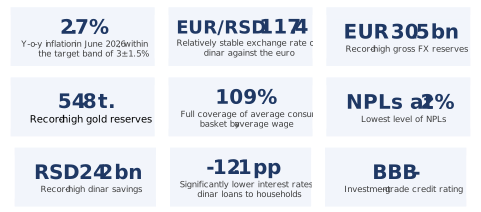
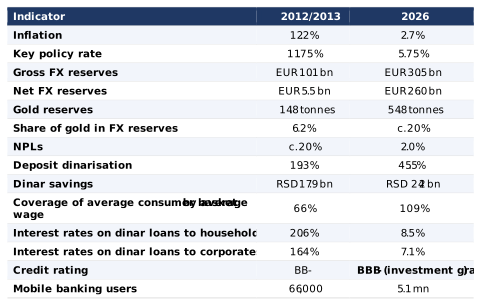
- We reduced the inherited high and volatile inflation by 10 pp in less than one year – from 12.2% at end-2012 to 2.2% in October 2013. We ended 2025 with inflation at 2.7%, which was also the inflation rate in June 2026, remaining within our target band of 3±1.5 pp.
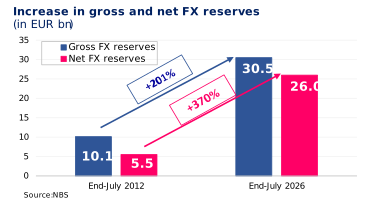
- Gross FX reserves have tripled. At end-July 2026, they stood at EUR 30.5 bn, EUR 20.4 bn higher than at end-July 2012. Over the same period, net FX reserves increased almost fivefold, from EUR 5.5 bn to EUR 26.0 bn.
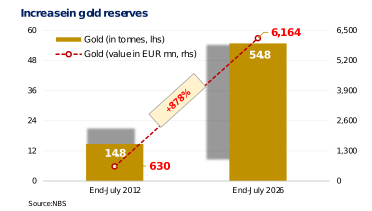
- The dinar appreciated by 1% in nominal terms against the euro, while the NBS purchased EUR 9.9 bn net in the FX market. Gold reserves increased by more than 3.5 times in volume, reaching a record 54.8 tonnes. Their value increased tenfold, while the share of gold in total FX reserves rose from 6.2% to around 20%.
LIVING STANDARDS AND SAVINGS
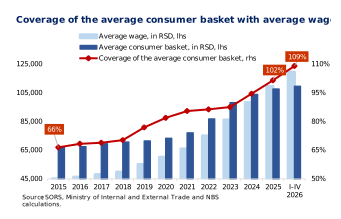
- The coverage of the average consumer basket by the average wage reached 109% in the first four months of 2026 (compared with 66% in 2013), while the coverage of the minimum consumer basket by the minimum wage reached 113% (compared with 59% in 2013).
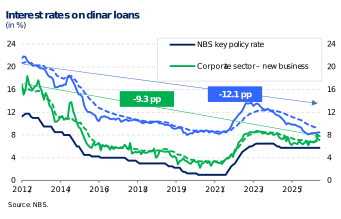
- Interest rates on new dinar loans to households and corporates are now 12.1 pp and 9.3 pp lower, respectively, than in May 2013.
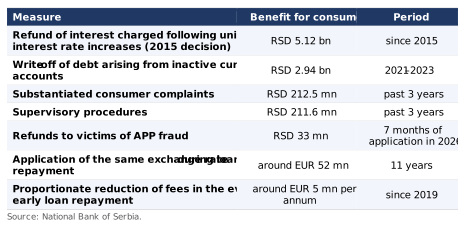
- Measures introduced to protect financial service consumers have returned or saved more than RSD 8.5 bn for citizens: RSD 5.12 bn through the reimbursement of unilaterally increased interest charges, RSD 2.94 bn through the write-off of debt on inactive current accounts, and more than RSD 420 mn over the past three years alone as a result of supervisory examinations and grounded complaints.
- Thanks to the rule requiring banks to apply the same exchange rate when loan repayments are made as was applied when the loan was disbursed, borrowers have paid banks around EUR 52 mn less over the past 11 years.
- Since 2019, banks have been required to reduce loan-related fees proportionately in the event of early loan repayment. The resulting benefit for borrowers amounts to around EUR 5 mn annually. EU member states will begin applying this rule only from the end of this year, and only to newly approved cash and consumer loans.
- We capped the exchange rate spread that authorised exchange dealers and the public postal operator may apply when buying and selling euros at ±1.25% relative to the official middle exchange rate. Since end-July 2019, package holidays have been charged using the official middle exchange rate of the dinar.
CONFIDENCE
- Serbia obtained an investment-grade credit rating from Standard & Poor’s in October 2024 and has maintained it despite heightened global geopolitical tensions. In doing so, we officially achieved one of our strategic objectives, although international investors had long before recognised Serbia as an investment-grade economy.
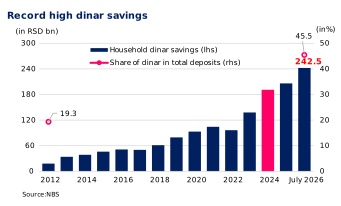
- Household savings have reached record levels. Dinar savings have exceeded RSD 240 bn, increasing thirteenfold over the past 14 years, while FX savings stand at almost EUR 17 bn (having doubled). The share of dinar savings in total savings has, for the first time, exceeded 10%.
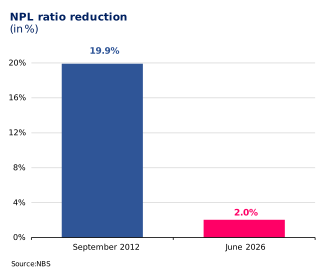
- The banking sector is stable, highly liquid and adequately capitalised. The share of NPLs in total banking sector loans has been reduced from around 20% to 2.0%.
- In 2019, Serbia became the first country in the region to be included on the list of jurisdictions whose banking supervisory and regulatory requirements are recognised as equivalent to those of the EU.
MODERNISATION, SECURITY AND MORE AFFORDABLE SERVICES
- On 22 May 2025, Serbia became the 41st member of SEPA. Since May 2026, 18 of the 19 banks operating in Serbia, as well as the NBS, in its capacity as a payment service provider for budget beneficiaries, have been executing euro payments in accordance with SEPA standards.
- The number of DinaCard payment cards issued is three times higher than in 2012, while interchange fees on card payment transactions have been reduced five- to sixfold – from an average of around 1% to 0.2% of the transaction value. Fees paid by merchants to banks for accepting payment cards have been halved, from more than 2% to around 1%.
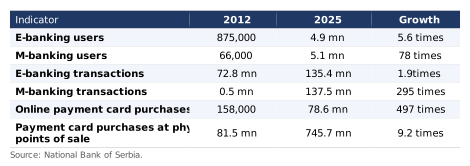
- The number of mobile banking users has increased 78-fold, from 66,000 at end-2012 to 5.1 mn at end-2025, while the number of transactions has increased 295 times. Over the same period, the number of electronic banking users has increased 5.6 times, from 875,000 to 4.9 mn.
- In 2025, 443 mn payments were processed through the NBS payment systems and the DinaCard system, twice as many as in 2012. More than 109 million payments were executed through the IPS system alone – equivalent to one payment every second on average.
- Every citizen has been guaranteed the right to a payment account with basic features, including digital services, while the process of switching payment service providers has been simplified.
- During 2025, more than 518,000 distance contracts were concluded, 30.7% of them using video identification. Since 2025, this service has also been provided by non-bank payment service providers.
RESULTS IN DETAIL
Investment-grade credit rating – Serbia’s historic achievement
- In October 2024, Standard & Poor’s assigned Serbia an investment-grade credit rating of BBB-. Serbia thus became the first non-EU country in South-East Europe with an investment-grade credit rating.
- This achievement was underpinned by the responsible conduct of economic policy, a high level of FX reserves, relative stability of the dinar against the euro, sustainable public finances, and a stable and resilient banking sector.
The issue of high inflation resolved and medium-term price stability preserved amid global shocks
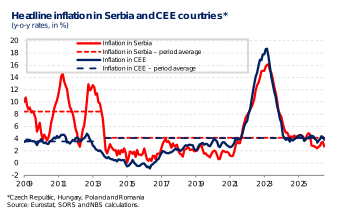
- Through timely and adequate measures, we reduced the inherited high inflation from 12.2% at end-2012 to 2.2% in October 2013. Over the following eight years, until the escalation of global inflationary pressures, inflation averaged around 2.0% and was comparable with the average inflation rate in Central European countries.
- The sustainable resolution of inherited inflation and the anchoring of inflation expectations enabled us, in 2017, to lower the inflation target from 4% to 3%, while maintaining the tolerance band of ±1.5 pp. This decision further confirmed our commitment, together with the Government, to maintaining low inflation over the medium term.
- Amid intensified global cost-push pressures, we made decisions that ensured inflation’s return to a downward path without slowing economic growth. Inflation has been declining since April 2023, returning to the target band of 3±1.5 pp in May 2024, and has remained within that band for almost the entire period since.
- The monetary policy framework itself also contributed to these results. The introduction of the variable multiple-rate auction model in December 2012 made the framework more flexible and efficient, which proved particularly important during the Covid-19 pandemic, the energy crisis, the conflict in Ukraine, and the sharp rise in global inflation. The NBS responded to these challenges promptly, prudently and gradually, enabling households and businesses to adjust as smoothly as possible to changing financial conditions.
- These achievements have helped anchor the inflation expectations of the financial sector, which rating agencies describe as “earned monetary policy credibility”.
Relative stability of the dinar exchange rate against the euro – a hallmark of the NBS
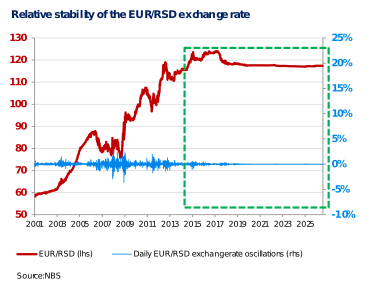
- Achieving and maintaining the relative stability of the dinar exchange rate against the euro is a distinctive achievement of the NBS.
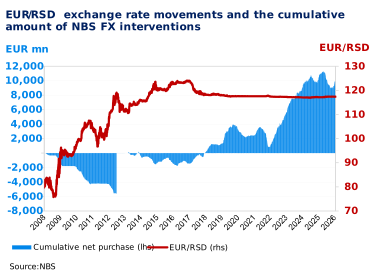
- Since August 2012, the dinar has appreciated by 1% against the euro in nominal terms, while the NBS has purchased as much as EUR 9.9 bn net through interventions in the domestic FX market.
- In addition to preserving the relative stability of the dinar exchange rate, the NBS contributes to the growth of FX reserves through net FX purchases, thereby further strengthening the resilience of the domestic economy and its financial stability. This is particularly important in the international environment marked by almost continuous global uncertainty and geopolitical crises.
- The developments in 2025 provide a good illustration of this, with simultaneous pressures stemming from the international environment and domestic factors associated with uncertainty surrounding the NIS company. The same is true for Q1 2026, when new geopolitical tensions emerged due to the situation in the Middle East. Under such circumstances, the NBS clearly demonstrated its readiness to use the accumulated FX reserves and intervene through FX sales.
- Since Q2 2026, due to the re-emergence of appreciation pressures on the dinar, our net FX purchases have offset three-quarters of the net FX sales recorded in Q1. This confirms our readiness to respond to challenges and demonstrates the appropriateness of our response.
FX reserves tripled, and their structure further strengthened
- Gross FX reserves, which stood at EUR 30.5 bn at end-July 2026, have tripled since end-July 2012, increasing by EUR 20.4 bn. Over the same period, net FX reserves increased almost fivefold, from EUR 5.5 bn to EUR 26.0 bn.
- In addition to the increase in FX reserves, their composition also strengthened – the quantity, value and share of gold increased significantly. Gold quantities increased more than three and a half times, rising from 14.8 tonnes at end-July 2012 to record high 54.8 tonnes, through purchases in the international market (a total of 17 tonnes in 2019, 2020 and 2024) and regular purchases from the domestic production. The entire quantity of gold is of the highest quality and purity (over 99.5%).
- The value of gold reserves increased tenfold, from EUR 0.6 bn to EUR 6.2 bn, while the share of gold in FX reserves rose from 6.2% to around 20%.
- Since July 2021, following the repatriation of 13 tonnes of gold (1 tonne received through succession and 12 tonnes purchased abroad), the bulk of gold reserves (49.8 tonnes) has been held in the vaults of the NBS, while the 5 tonnes purchased abroad in early July 2024 are currently held in the NBS’s special account in Bern.
Confidence in the dinar rises while dinar savings post record highs
- Compared with end-2012, dinar savings increased thirteenfold, with particularly pronounced growth recorded in the past few years.
- In July 2026, dinar savings exceeded RSD 240 bn for the first time (it stood at RSD 242.5 bn), while their share in total savings reached over 10%.
- Greater use of the dinar enhances monetary policy efficiency – the dinarisation of corporate and household deposits increased from 19.3% to 45.5%, while the dinarisation of receivables rose from 28.0% to a record high of 40.7%.
- The growth in both dinar and FX savings confirms citizens’ confidence in the central bank and the banking system, while the rising use of the dinar in the domestic financial system provides the strongest evidence of growing confidence in monetary policy and the national currency.
Rising standard of living and significantly more favourable financing conditions
- The coverage of the average consumer basket with the average wage amounted to 109% in the first four months of 2026, which is over 40 pp higher than in 2013 (66%). The coverage of the minimum consumer basket with the minimum wage amounted to 113%, almost 55 pp higher than in 2013 (59%).
- Since May 2013, when we started the monetary easing cycle, we have lowered the key policy rate from 11.75% to 2.25%, where it stood in November 2019. During the initial phase of the pandemic, amid lower demand, we reduced it further to its historical low of 1% in December 2020.
- Amid strong global inflationary pressures, we tightened monetary policy in 2022 and 2023 by raising the rate to 6.5%, and as inflationary pressures eased, we lowered it to its current level of 5.75%.
- As a result, in June this year, the interest rates on dinar loans to households and corporates were lower by 12.1 pp and 9.3 pp, respectively, compared with May 2013. The decline in the interest rates on both dinar and euro and euro-indexed loans was also supported by the lower country risk premium, stronger competition in the banking sector and the systemic capping of interest rates on household loans.
- For citizens, this means greater access and lower cost of consumer and housing loans, facilitating the financing of expenditures and important life investments, thereby improving the quality of life. At the same time, for the corporate sector this means more favourable sources of financing, easier access to funds for new investments and business improvement, and, hence, support to the expansion of production capacities, employment growth and the strengthening of the competitiveness of the domestic economy.
A sound and stable banking sector as the pillar of support to businesses and citizens
Thanks to the decisive, responsible and comprehensive measures that we have continuously implemented since 2012, the banking sector in Serbia is now stable, delivers sound financial results and has sufficient capital to cover the risks it assumes and provide strong support to the corporate sector and citizens.
- Due to inadequate management and supervision before 2012, and with the aim of strengthening the stability of the banking sector, we were forced to close four banks between end-2012 and end-2014. In order to prevent similar situations in the future, we comprehensively improved the regulatory framework governing banks’ operations and banking supervision.
- The gradual and controlled consolidation of the sector enabled continuous improvements in the quality and range of services available to citizens and the corporate sector.
- Thanks to the proactive measures of the NBS aimed at preventing the emergence of NPLs, as well as the stable macroeconomic environment, their share declined to a historical low of 2.0%.
Amid global uncertainties that have persisted since the coronavirus pandemic, we have taken all necessary measures to ease the impact of crisis periods on citizens and business, while preserving financial stability.
- In 2020, we enabled citizens and businesses to benefit from a moratorium on the repayment of loans and leasing obligations on two occasions (in March and July), which was used by more than 90% and 80% of debtors, respectively. Rescheduling and refinancing of the obligations of bank and leasing company clients that were particularly affected by the pandemic were also enabled. Facilities, totalling RSD 111 bn, were approved for more than 50,000 clients.
- Farmers, including persons engaged in the purchase and cold storage of fruit, were also enabled to reschedule their loan obligations with banks and leasing providers. As at end-June 2026, around RSD 5.4 bn of agricultural loans were being repaid under more favourable terms.
- As at end-June 2026, around 8,000 individual borrowers used the possibility of restructuring cash loans, consumer loans and other similar loans, in the total amount of RSD 6.8 bn.
- Amid a sharp and significant increase in EURIBOR rates, in September 2023, we temporarily capped interest rates on euro-denominated housing loans, which brought down the interest rates on housing loans by 2 pp on average, while loan instalments were brought down by between 10% and more than 25%. In 2025, this issue was addressed systemically and permanently through amendments to the Law on the Protection of Financial Service Consumers, providing citizens with certainty regarding the maximum level of interest rates not only on housing loans but also on other credit products (cash loans, consumer loans, credit cards and current account overdrafts).
- As a result, average nominal interest rates on new housing loans declined from 6.5% in September 2023 to 4.5% in June 2026, while those on cash loans fell from 10.2% in December 2024 to 8.4% in June 2026. At the same time, between December 2024 and June 2026, interest rates on current account overdrafts subsided from 27.9% to 17%, and rates on credit card borrowing – from 22.3% to 14.4%.
- In line with the NBS’s supervisory expectations, by the end of June 2026 banks approved more than 440,000 loans specifically intended for lower-income households and pensioners, in the total amount of over RSD 350 bn. More favourable lending terms also enabled the refinancing of existing loans at significantly lower interest rates.
- We have also supported the government youth housing loans programme, under which nearly 7,500 loans, totalling around EUR 585 mn, have been approved. The utilisation of 65% of the available EUR 900 mn confirms the programme’s importance in helping citizens address their housing needs.
Safe and sound payment system operation, enhanced speed and availability of services
The NBS ensures safe and sound operation of six payment systems. We have established a modern legal framework for payment services that fosters innovation and market competition, in line with European and international best practices.
- We developed the NBS IPS system, enabling citizens and businesses to make payments anytime and anywhere, with funds credited to the recipient’s account within a matter of seconds. There are different methods for making instant payments at points of sale (IPS Show and IPS Scan), including deep-link technology which enables completely secure payments at online points of sale using a single device.
- The Transfer (Prenesi) service allows citizens to make instant payments simply by entering the recipient’s registered mobile phone number or selecting it from their contacts, without the need to remember payment templates or enter the recipient’s account number. Monthly bills can be paid by scanning the NBS IPS QR code, eliminating the need to manually enter payment details – 30.2 mn payments were executed in this way in 2025. The same mechanism has been implemented in the e-Pay project, enabling electronic payment of fees for Ministry of the Interior services related to the issuance of personal documents.
- We also support innovation in the field of payments through a regulatory sandbox, a controlled environment for testing innovative solutions that is also available to start-up companies.
We have continuously enhanced the national DinaCard payment card system:
- The number of issued DinaCard cards has tripled compared to 2012, and since 1 June 2024 all newly issued cards have been contactless. DinaCard debit cardholders can also pay in instalments, as an alternative to cheques, and withdraw cash at the point of sale when making a purchase at all NIS Petrol and Gazprom petrol stations, as well as at all Mercator, Roda, IDEA, Maxi and Tempo retail outlets.
- DinaCard cards can be used for online payments at around 3,500 merchants, with more than 16.6 mn transactions executed in this way in 2025.
- We also issue the international DinaCard card, which can be used abroad. Around 670,000 chip-based DinaCard–Discover cards have been issued. In Serbia, they are used as domestic payment cards, while abroad they can be used across the Discover acceptance network in more than 200 countries and territories.
- In 2018, we signed a cooperation agreement with the Chinese national card scheme UnionPay, providing for the acceptance of UnionPay cards across the DinaCard acceptance network, followed by the issuance of the co-branded contactless DinaCard–UnionPay card. The card can be used within the DinaCard acceptance network in Serbia and across the UnionPay acceptance network in more than 180 countries. Today, UnionPay cards are accepted at 77% of POS terminals and 92% of ATMs within the DinaCard acceptance network, with around 53,000 transactions executed each month.
Thanks to a modern legal framework governing the provision of payment services and a modern payment infrastructure, the use of payment services, electronic services and cashless payment methods has increased significantly over the past fourteen years. During this period, the following was achieved:
A total of 443 mn payments were processed in 2025 through the payment systems operated by the NBS and the NBS DinaCard system, representing an increase of 99.9% compared with the total number of transactions executed through the payment systems in 2012, when 221.6 mn payments were processed.
In the NBS IPS system alone, 109.3 mn instant payments were executed in 2025, averaging around 300,000 transactions per day, with an average execution time of just one second. Since the launch of the NBS IPS system, around 470 mn transactions, with a total value of around RSD 5,355 bn, have been executed.
In 2018, the possibility to conclude contracts remotely and via video identification of users was introduced, and since then the number of concluded contracts has increased every year.
- In 2025, a total of 518,184 distance contracts were concluded, 11.7 times as many as in 2019, when 44,295 such contracts were concluded.
- In 2025, 30.7% of contracts were concluded through video identification, while 69.3% were concluded using other electronic means.
Enhanced financial service consumer protection has delivered substantial financial benefits
Over the past fourteen years, the NBS has undertaken numerous activities within the scope of its financial service consumer protection function. We have continuously improved the relevant laws and bylaws, while regularly applying all their instruments and mechanisms, which has resulted in significant direct positive financial benefits for consumers.
Financial benefits of financial service consumer protection measures
- The new Law on the Protection of Financial Service Consumers was adopted last year at the proposal of the NBS. Among other things, the Law introduced interest rate caps for all types of loans and requires banks to offer customers repayment relief measures in certain circumstances. Initial reports show that banks approved 79% of applications for repayment relief. In addition to extending repayment periods, the most frequently applied relief measures were interest rate reductions and temporary suspension of loan repayments.
- We initiated amendments to the Law on Payment Services enabling the reimbursement of consumers who are victims of APP fraud (investment fraud, romance scams, WhatsApp scams and similar types of fraud). During the seven months of implementation of this measure, banks have managed to freeze funds in the accounts used for fraudulent activities and reimburse affected consumers in the amount of RSD 33 mn. We expect this measure to deliver even greater results in the coming period.
- Based on the opinion of the NBS issued at the end of 2019, at the time of full early loan repayment banks are required to proportionately reduce the one-off loan fee. By way of comparison, this rule will be applied by European Union countries only from the end of this year, and only to newly granted, exclusively cash and consumer, loans. The effect of this measure for consumers in the initial years of its application amounted to around EUR 5 mn annually.
- We are one of the few countries that have regulated the advertising of financial services in detail as far back as in 2019, establishing complete order in this area and ensuring that all information provided in advertisements today is accurate, unambiguous and complete. In this regard, several supervisory procedures have been conducted and measures have been imposed on banks that failed to comply with these rules.
- By means of a special decision adopted in 2015, the NBS required banks to reimburse all customers who had been subject to unilateral interest rate increases for the amount of interest charged as a result of such increases. Based on this measure, a total of RSD 5.12 bn was returned to customers.
- Although the 2011 Law on the Protection of Financial Service Consumers introduced the obligation for banks to apply the middle exchange rate when disbursing and repaying loans, all customers who had taken out loans before that date continued to be exposed to unfavourable exchange rate differences. Therefore, amendments to this Law adopted in 2014 introduced the obligation for banks to apply, at the time of loan repayment, the same type of exchange rate that was applied when the loan was disbursed to the consumer. Estimates indicate that, thanks to this regulatory intervention, over the 11 years since this rule has been in force, consumers have paid banks around EUR 52 mn less in loan repayments.
- Nine procedures were conducted in which it was established that banks had included unfair contractual provisions in agreements or applied unfair business practices. In this regard, certain measures were imposed, and all banks were also informed so that they could align their contracts and practices with the findings from these procedures.
- Based on supervisory procedures conducted in the past three years alone, consumers have received benefits amounting to RSD 211.6 mn, most often in the form of refunds.
- Over the past three years, we have resolved nearly 6,900 complaints from financial services consumers. Each complaint received due attention, as evidenced by the fact that as many as 42% of complaints against banks were resolved in favour of consumers, while 20% of complaints against insurance companies were found to be substantiated. The positive effect for consumers whose complaints were substantiated amounted to more than RSD 212.5 mn over this three-year period.
- Based on the measures taken by the NBS, banks wrote off RSD 2.94 bn of consumers’ debt arising from inactive current accounts in the period from 2021 to 2023.
- We have actively promoted competition and customer mobility, successfully simplifying the process of loan refinancing and, more broadly, of switching banks.
- Our constant vigilance and proactive approach in this area increase the legal risk for all market participants seeking to operate on the margins of regulatory requirements and make the detection of irregularities and the imposition of sanctions highly certain.
Comprehensive regulatory reforms enabled accession to the SEPA area and SEPA payment schemes
- By successfully coordinating the process of Serbia’s accession to SEPA in 2025, the NBS created the necessary conditions for domestic payment service providers to access SEPA payment schemes as of May 2026.
- Eighteen out of 19 banks in Serbia have joined the SEPA Credit Transfer (SCT) scheme, enabling citizens and businesses to make faster, simpler, more transparent and more affordable euro payments with countries participating in SEPA.
- The possibility of making payments through SEPA payment schemes enhances the competitiveness of the domestic economy, facilitating business with European partners and increasing the predictability of financial flows, while enabling citizens to settle their cross-border financial obligations in accordance with the same rules and standards applicable throughout the European payments area.
Security and protection of citizens in exchange transactions
- As the regulator and supervisor of FX and exchange operations since 1 January 2019, the NBS has ensured the security and protection of the citizens of the Republic of Serbia in the FX and exchange market.
- We have capped the minimum buying and the maximum selling exchange rate that authorised exchange dealers and the public postal operator may apply when purchasing and selling euro cash to ±1.25% relative to the official middle exchange rate of the dinar against the euro applicable on that day, while the exchange transaction fee has been abolished.
- We have also resolved the long-standing issue of charging for package travel arrangements using banks’ selling exchange rates for foreign exchange or foreign cash. Since end-July 2019, the official middle exchange rate of the dinar has been applied when displaying prices and charging for package travel arrangements abroad.
Continuous protection of the rights and interests of policyholders
Over the past fourteen years, the NBS has remained committed to ensuring stable and predictable business conditions in the insurance market, as well as protecting the rights and interests of policyholders and other insurance service users.
- The number of insurance contracts increased from 5.9 million in 2016 to 9.5 million in 2025, while the number of complaints relating to insurance services remained almost unchanged – at around 19,000 annually. This confirms a stable level of protection of insurance users and the importance of the continuous improvement of market conduct.
- Total premium increased from RSD 61.5 bn in 2012 to RSD 191.5 bn in 2025.
- Premium per capita increased more than threefold over the past fourteen years (from EUR 75 to EUR 249).
- Life insurance premium increased from RSD 11.9 bn to RSD 34.1 bn, while compensation paid to policyholders, i.e. natural and legal persons, recorded stronger growth than insurance premium (claims settled increased 3.6 times, while insurance premium increased 3.1 times).
Numerous legislative solutions in the best interest of citizens and businesses
Through our regulatory activities, we have enabled:
- a modern legal framework that provides the NBS with adequate instruments for the implementation of monetary and FX policies and guarantees its independence (amendments to the Law on the National Bank of Serbia adopted in 2012, 2015, 2018 and 2025);
- changes to the bank resolution framework that ensure the continuity of banks’ critical functions, while providing full protection to depositors and ensuring the lowest possible cost to the state, as demonstrated in practice in the case of Sberbank (amendments to the Law on Banks adopted in 2015 and 2025);
- the establishment of an ecosystem for innovative solutions in the digital assets market and its proper development (the Law on Digital Assets and the complete set of by-laws for its implementation), together with the emergence of the first entities licensed by the NBS to provide services related to virtual currencies in the domestic market in accordance with international standards;
- the modernisation of payment services in domestic and international transactions and greater competition in the payment services market (the Law on Payment Services and its amendments adopted in 2018 and 2024);
- greater uniformity, lower costs and increased transparency of costs related to payments by citizens and businesses (the Law on Multilateral Interchange Fees and Special Operating Rules for Card-based Payment Transactions, and the Decision on the Payment Account with Basic Features);
- stronger protection and an improved position of financial service consumers (the Law on the Protection of Financial Service Consumers), particularly in the context of the growing use of information and communication technologies (the Law on the Protection of Financial Service Consumers in Distance Contracts);
- the introduction of financial collateral in line with international standards into the domestic financial market, thereby enhancing legal certainty and efficiency in the fulfilment of obligations in the financial market, reducing credit and systemic risks (the Law on Financial Collateral), and contributing to the development of the financial market;
- improvements to the legal framework governing the capital market through active participation in the preparation of the new Law on the Capital Market, as well as strategies for capital market development;
- enhanced supervision by the NBS over exchange operations and FX operations, the introduction of stricter measures and additional obligations for exchange dealers aimed at protecting citizens conducting exchange transactions and ensuring transparent and secure exchange operations (amendments to the Law on Foreign Exchange Operations adopted in 2025).
Significant progress has been achieved in combating money laundering and terrorism financing.
- The NBS’s extensive legislative activities in the area of combating money laundering, terrorism financing and the financing of the proliferation of weapons of mass destruction, carried out together with other competent authorities, have enabled improvements to the legal framework governing this area.
- The NBS’s role in this field has also been recognised through the highest compliance ratings with international standards assigned by the relevant international institutions (FATF and MONEYVAL), not only in respect of the regulations governing the operations of financial institutions supervised by the NBS, but also regarding the effectiveness of their implementation.
- By the end of 2023, Serbia had achieved compliance with all 40 FATF Recommendations. Following the subsequent evaluation, in December 2025 MONEYVAL placed Serbia under its regular follow-up procedure, which is the best possible outcome a country can achieve following a MONEYVAL mutual evaluation.
- This result confirms the high degree of compliance and effectiveness of the AML-CFT system and contributes to confidence in the domestic financial system.
European integration
- We are among the central banks with the broadest range of responsibilities within the European integration process. We chair two important negotiating groups – Financial services (Chapter 9) and Economic and monetary policy (Chapter 17) – and serve as the second competent institution for Chapter 4 – Free movement of capital. All three chapters have been opened. We also participate in the work of eight other negotiating chapters.
- In 2026, we prepared and submitted to the European Commission for consultation nine draft laws, including the Draft Law on Credit Institutions, the Draft Law on Insurance and the Draft Law Amending the Law on the National Bank of Serbia.
- Additional confirmation of the NBS’s contribution to Serbia’s European integration is reflected in the European Commission’s assessment in the Serbia Progress Report, in the section relating to the economic criteria, in the fulfilment of which the NBS plays a significant role.
Cooperation with the IMF
Since 2012, we have successfully implemented, in cooperation with the IMF:
- one precautionary stand-by arrangement (without drawing the available funds),
- one stand-by arrangement introduced during the global energy crisis (successfully completed ahead of schedule), and
- two non-financial Policy Coordination Instruments, intended for countries pursuing credible economic policies.
Cooperation is currently ongoing under the third Policy Coordination Instrument, whose third review was also successfully completed in June this year.
The highest officials of the IMF have given numerous positive assessments of Serbia’s progress:
- Serbia is a bright spot in Europe.
- The country’s fundamentals are strong.
- Serbia has built strong buffers, and it is important to preserve them, as many countries do not have them.
- The resilience demonstrated by the Serbian economy is impressive!
- The high level of confidence in Serbia has been earned through hard work and results, new jobs and a higher standard of living. Credibility is earned through actions, not words.
A stable and predictable business environment supports investment in Serbia
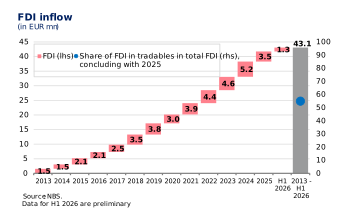
- Between 2013 and 2025, FDIs in Serbia amounted to EUR 41.7 bn, or EUR 43.1 bn including H1 2026.
- Around 55% of these investments were directed to export-oriented sectors, contributing to the expansion and diversification of Serbia’s export base and increasing the coverage of imports of goods and services by exports – from 67% in 2012 to 92% in 2025, and to 95% since the beginning of the current year.
Human resources – the foundation of the institution’s long-term stability
The long-term stability of an institution relies not only on regulations and strategies, but above all on the people who manage these processes professionally and responsibly on a daily basis.
- More than 900 students have completed student internship programmes, including those organised in cooperation with higher education institutions in the Republic of Srpska, and the best among them have become members of the NBS’s team.
- By recruiting the most talented senior undergraduate students, we have significantly increased the share of employees under the age of 30 – from 5.73% in 2012 to 12.08% in 2026.
- The qualification structure of our employees has improved significantly – employees holding a university degree account for 40.8% of the total number of employees.
“Over the past fourteen years, we have demonstrated that results are not subject to negotiation – we have built them steadily, year after year, regardless of where the shocks from the international environment came from. This will remain our way of working in the period ahead because we have shown that persistence and responsibility outlast every crisis. During each of these fourteen years, we did not seek shortcuts, and we will not seek them in the future. Every change in the environment has been an additional signal for us to think ahead, because that is the only way to ensure that what we have built will endure”, Governor Jorgovanka Tabaković concluded.
Governor’s Office